
Guilty or Not Guilty: In Our Role it’s Irrelevant
I was recently looking for something to watch on TV when I stumbled upon Amer Heard’s direct testimony during the Johnny Depp vs Amber Heard trial. I didn’t know anything about them as a couple at the time. I knew who Johnny Depp was. I had seen the movie Secret Window over 15 years ago when it came out. I didn’t know Amber Heard, had never watched her acting nor seen any of her pictures.
Because of my interest in legal matters and witness testimony, I kept watching for a while. When Amber was being cross-examined, her credibility was impeached over and over again. At that point, armed with the only information I had, in my mind she sounded like someone who was lying. Knowing perfectly well that the information I had was extremely one sided, I got curious and started to watch the trial from the beginning.
My main thought, as I continued to watch the Depp vs Heard trial, was that a good attorney can always make a good case. Plaintiff and defendant attorneys both made good points. Both parties were able to make most of the opposing witnesses sound as if they were lying, being dishonest, or at the very least, less than candid.
By the time I had finished watching the whole trial, I had unwittingly learned of its outcome already while searching for other information on the case. In my view, either side could have won had circumstances been different, as they were in the U.K. trial. If you did not watch either trial, suffice it to say that in the U.S. trial, Johnny Depp was awarded $10.3 million, and Amber Heard was awarded $2 million. Conversely, in the U.K. trial, Mr. Depp lost the case over similar issues surrounding his relationship with Ms. Heard.
I know that the verdict was controversial, so I will reserve my views on that. My objective was only to learn terminology, legal processes, and how objections are handled and why (I did tons of research afterwards), just out of pure curiosity. In the court cases I participate as an interpreter, my view is that the opposing parties are not necessarily lying. They just have very different perspectives.
The point of all of this was that I felt compassion for both sides because, whatever their faults or mistakes had been, their lives were being paraded in front of the world. We have all said and done things that, if exposed, would embarrass us. Who hasn’t raised their voice in anger or cursed or been less than kind to their loved ones? We are human, and as such we make mistakes. We are not perfect. I am not comparing everyone’s behavior to the extreme things I heard during the trial. All I am saying is that perfection does not belong to anyone. The people we encounter in court are as imperfect as we are, and for me the lesson was that all of them, despite what they may be accused of, are people, and regardless of what they have done, they deserve to be treated with respect.
In our ordinary role as judiciary interpreters, we see people who have been accused of heinous crimes sometimes, and a few of the things we hear in court can be difficult to process and be emotionally tolling, but we have to remain objective and give people the benefit of the doubt. We are not there to judge. We can’t go to a job with preconceived notions as to who is guilty or not. That is not our job.
We must be impartial at all times. Then, from my perspective as a Catholic and a Christian, I have to act with Christian charity. My obligation is to be, if not distinctly kind—since that falls outside of my role—at least impartial and treat people with the dignity they all deserve regardless of what they are alleged to have done. In the end, we are all fallible, all of us. Attorneys, judges, court personnel, interpreters, we are all share the same human nature and are entitled to be treated with the same level of dignity as anyone else, whether guilty or not.
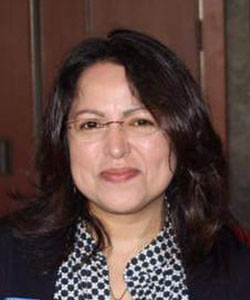
Hilda Zavala-Shymanik is a state certified/approved Spanish court interpreter and translator with more than fifteen years of experience in legal, medical, corporate, and non-profit settings in New York, New Jersey, Illinois, and Wisconsin. She is a board member, treasurer, Conference Committee chair, member of the Training and Education Committee and blog team of the National Association of Judiciary Interpreters and Translators as well as former president of the New York Circle of Translators. She is an active and voting member of NAJIT, ATA, and other professional groups. Hilda has two certificates in Legal Interpreting in Spanish and English, the latest one from NYU. Hilda is a former a Staff Interpreter at Essex County Superior Court in New Jersey, where she worked for six years. She now lives and works as a freelance interpreter in the Chicagoland area. Born in Chicago, Hilda lived for twenty years in Mexico and loves traveling. She continuously looks for opportunities to promote and advance the interpreting profession. Contact: hzavala@najit.org

We love to hear from our readers! If you wish to make a comment on this blog post, please use the comment box on the page below the post.
Categories
Select Category
Archives
Select Month
The views and opinions expressed are those of the author and do not necessarily reflect the official position of NAJIT.
Recent Posts