
Exploring ways to do business: An Interpreter Run Cooperative
We are always writing about colleagues asking us about fees, and we are horrified when we learn of new colleagues being lowballed. This is an everyday issue. Many blog writers and other guests write about this subject, and we tend to despair of ever having interpreter fees accurately reflect our skills. Maybe it is time to think of new business structures?
Today, a colleague offered an assignment in a professional chat, and a few of our friends mentioned that the proposed fee was low. Then the conversation turned from low- to high-range fees and the differences between compensation from law firms, courts, and agencies. One of my colleagues brought up an idea that I have been hearing for the last two years. I believe I first heard about this concept the first time I met Reme Bashi, or perhaps the second. I have since talked to other colleagues about the idea of coming together to open a cooperative run for and by interpreters.
What would it take to create a cooperative? I have been reading on the subject from different websites, including the IRS rules for this type of legal entity, and it does not sound more complicated than what we already do, most of us already being self-employed. Among us are agency owners, former agency owners, and former agency employees. So, what is stopping us from making this dream or goal a reality?
Cooperatives are often created in the context of agricultural production, but they can function for many types of products and services. The University of Nebraska’s Cooperative Development Center defines a cooperative as follows:
A cooperative is an association of persons (organization) that is owned and controlled by the people to meet their common economic, social, and/or cultural needs and aspirations through a jointly owned and democratically controlled business (enterprise). The people of the cooperative are those who use its products, supplies, and/or services. Profits are also often returned back to the members of the cooperative; however, cooperatives are often more focused on services for members than for investments.
Cooperatives can be created for a number of different reasons or to fulfill a number of different needs: jointly process goods, split costs, split control over work, purchasing power (bulk buys), shared employees, shared wages, etc.
Aside from our language skills, most of us have run businesses of one kind or another. I for example worked in accounting, administration, and human resources for fifteen years before becoming an interpreter. Many of my colleagues have been or are still working as flight attendants, communicators, photographers, graphic designers, professors, teachers, real-estate agents, writers, and more. Therefore, we all have a combined variety of skills that could be very useful for this kind of project, from logos to tag lines and administration, and more.
One of the reasons I have not attempted this before is that someone needs to take it on and get people organized. There needs to be a leader or a group of leaders. Most of my colleagues (closest friends) are in my age group, and for the most part, we are all set as far as our income and commitments are concerned. Some of us, myself included, are planning to retire within the next five years. We need someone from a younger generation ready to step up to the plate, take this idea, and run with it. I am sure you can get a lot of support from colleagues already doing this. I believe we have one in my neck of the woods, actually!
If you are interested in this idea, it is time to get enough volunteers to research it and see it if it is a viable option for you, to get organized and explore all business possibilities.
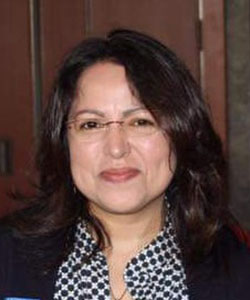
Hilda Zavala-Shymanik is a state certified/approved Spanish court interpreter and translator with more than seventeen years of experience in legal, medical, corporate, and non-profit settings in New York, New Jersey, Illinois, and Wisconsin and is certified/approved in those four states. Hilda is a former Vice Chair, Board Member, Treasurer, Conference Committee Chair, member of the Training and Education and Advocacy Committees, and current member of the blog team and Chair of the Elections Committee of the National Association of Judiciary Interpreters and Translators, as well as former president of the New York Circle of Translators.
She is an active and voting member of NAJIT, ATA, MATI and other professional groups. Hilda has two certificates in Legal Interpreting in Spanish and English, the latest one from NYU. Hilda is the current staff interpreter of the 23rd Illinois Judicial Circuit as well as a Cook County (Illinois) Spanish Interpreter employee. Hilda is a former Staff Interpreter at Essex County Superior Court in New Jersey, where she worked for six years. Born in Chicago, Hilda lived for twenty years in Mexico and loves traveling. She continuously looks for opportunities to promote and advance the interpreting profession. Contact: hshymanik@yahoo.com
We love to hear from our readers! If you wish to make a comment on this blog post, please use the comment box on the page below the post.
Categories
Select Category
Archives
Select Month
The views and opinions expressed are those of the author and do not necessarily reflect the official position of NAJIT.
Recent Posts