

Go Team!

NAJIT Editor • July 2, 2026

Share this article

Go Team!

By: Reme Bashi

As I write this blog entry, the World  Cup is in progress. Many of you are probably following a team and rooting for their success. Even if we are not usually big soccer fans, it is almost inevitable to get caught up in the team spirit. As I walked into work on the day of the Cup opening, I was surprised to see my colleagues dressed in their team colors. Someone had even made a soccer ball-shaped sandwich to share with us! When we come together and cheer for a team, it creates energy and draws attention. Why not do the same with standards in our profession?


With the recent publication of NAJIT’s Position Paper on Team Interpreting, this seems like the perfect season to raise the team interpreting banners. Let’s make some noise. Go team! Team judiciary interpreting all the way!


High quality in the field of interpreting is a team effort. Many of us are fortunate to know this through experience, and the NAJIT position paper does an excellent job of laying out the many compelling reasons why team interpreting is the standard in our profession. My gratitude goes out to everyone who authored and reviewed this paper. If you have not yet had a chance to read this hot-off-the-press publication, you can find it below!
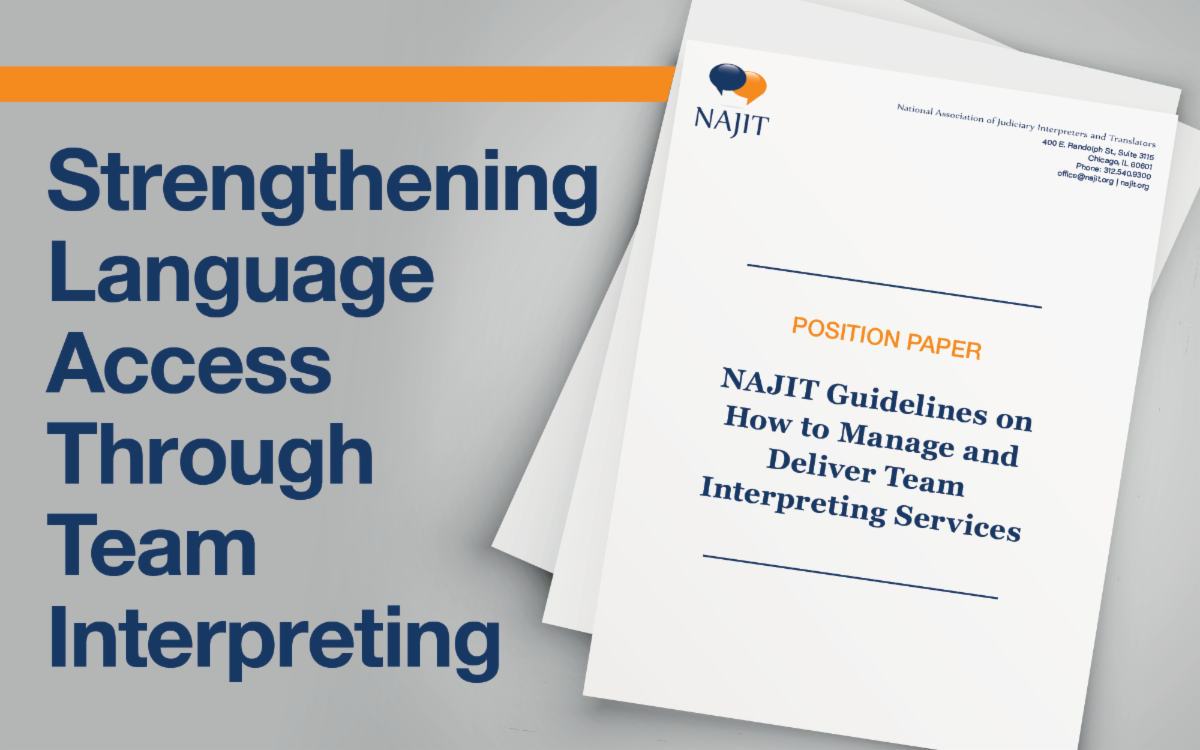

I am fortunate to work in courts where the value of team interpreting, and the reasons behind it, are well understood. If you are not working in a setting that recognizes the importance of team interpreting, having this position paper as a foundation for requesting a team can be extremely useful.


Let’s share advice on successful team interpreting. I will read yours in the comments. Here are some considerations I have found helpful in my own experience.

When you are asked to work a lengthy assignment, ask who the other interpreter is before accepting it. If your client has not hired a second interpreter, be ready to refer a few colleagues you work well with. Avoid letting clients assume that a particular hearing or deposition can be handled by a single interpreter. Take every opportunity to educate them on why we work in teams. Never forget that interpreters are the professionals best positioned to explain the standards that support accurate interpretation.


If you get pushback and the person scheduling does not understand why you need a partner, frame your reasons in terms of accuracy of interpretation rather than focusing on the need for breaks. For a non-interpreter, it can be difficult to grasp the reality of interpreter fatigue. I have heard comments such as, “The court reporter won’t need a break.” Reframing the conversation around accuracy and quality can help clients better understand why team interpreting matters.


When working with a client who is unfamiliar with team interpreting, it is helpful to explain the dynamics of how it works. I have sometimes assumed a judge understood team interpreting, only to have him or her try to manage our switches. Although well intentioned, that kind of intervention defeats the purpose of seamless switching, and as we know, interpreters should determine when a switch happens. Beyond the agreed interpreting time, there may be other reasons for a switch, and a third party is not necessarily aware of them.


Whenever possible, team up with interpreters who share your understanding of how team interpreting works. Team interpreting is a delicate dance, best performed with a partner with whom you have a strong working relationship. When you know your teammate well, you most likely already have agreements about role responsibilities, such as who is the active and passive interpreter, how long each interpreting turn will be, and how to handle error corrections.


Teaming up with any interpreter is better than working solo, but if you are truly aiming for the highest possible quality of the end product, having the ability to choose your teammate can make a difference.


I have said this before, and I will say it again: set aside unnecessary competition and team up to support each other’s work. Focus on your colleagues’ strengths. Collaboration is the answer to a successful team interpreting assignment, and to anything else we set out to do as a profession.


Keep the Conversation Going

If this topic resonated with you, be sure to check out our previous blog posts for more insights on the realities of our profession, and the evolving world of judiciary translation and interpreting:

Be a Swan, Not a Duck — What does being a swan, not a duck, look like in your interpreting practice?

The Couch: Is There Still a Lane for Newcomers? — Is there still a strong path into judiciary translation and interpreting for newcomers entering the profession today?

The Conference Between the Sessions — What happens when more than 350 language access professionals come together to learn, connect, and build community?

You can find these and more in our blog archives!

Interested in sharing your insights with our community? Check out Writing for The NAJIT Observer to learn how you can contribute.

The images used in this post are sourced from Unsplash, Pixabay, AI generated, and/or credited to their rightful owner. They are used for illustrative purposes only.


The views and opinions expressed in this post are those of the author(s) and do not necessarily reflect the official position, policies, or views of the NAJIT Board of Directors or the organization as a whole. Content published in The NAJIT Observer is intended to encourage professional dialogue, reflection, and community engagement. Reader discretion is advised where topics may involve complex ethical, professional, or emotionally sensitive subject matter.


Reme Bashi


Blog Writer and Proofreader


Hello, everyone, I’m Reme Bashi, and I have been a certified court interpreter in Wisconsin since 2008. My career began in Mexico, where I majored in pedagogy at the University of Veracruz and transitioned from language teaching to interpreting and translation. Over the years, I have gained experience in education, manufacturing, legal, and community settings, including conference interpreting for media and government events. I’m passionate about continuous learning, which I believe is essential for growth in our profession. Recently, I have ventured into areas like hospitality, urban gardening, and ancestry research, enriching my perspective as an interpreter and writer. I look forward to contributing content that sparks dialogue and deepens our understanding of the field.

We love to hear from our readers! If you wish to make a comment on this blog post, please use the comment box on the page below the post.

Categories

Archives

Select Month

The views and opinions expressed are those of the author and do not necessarily reflect the official position of NAJIT.

Recent Posts

The Naij Observer logo with blue and orange speech bubbles
By The Observer Editor June 17, 2026
Language is Evocative
By Observer Editor June 10, 2026
The Conference Between the Sessions
By The Observer Editor June 4, 2026
The Couch: Is There Still a Lane for Newcomers?
By Observer Editor May 28, 2026
B e a Swan, Not a Duck
By Observer Editor May 21, 2026
Wait… So What’s the Difference Between The Blog, CyberNews, and Proteus?
The NAJIT Observer logo featuring the words 'The NAJIT Observer' with two overlapping speech bubbles
By Observer Editor May 14, 2026
Court interpreting can be an isolating profession. This post explores the importance of building trusted professional networks, mentorship, and community within the interpreting field.
The NAJIT Observer logo featuring the words 'The NAJIT Observer' with two overlapping speech bubbles
By Observer Editor May 7, 2026
When AI-generated summaries begin influencing how interpreted testimony is remembered and discussed, where does ethical responsibility begin? This edition of “Let’s Test Your Ethics” explores the risks of administrative AI creep in the courtroom.
The NAJIT Observer logo featuring the words 'The NAJIT Observer' with two overlapping speech bubbles
By Observer Editor April 30, 2026
A reflection on the NAJIT 2026 Conference, highlighting community, connection, and the evolving role of judiciary interpreters and translators.
The NAJIT Observer logo featuring the words 'The NAJIT Observer' with two overlapping speech bubbles
By Observer Editor April 22, 2026
Preparing for the FCICE? These practical tips break down how to train effectively, avoid common mistakes, and build the discipline needed for federal certification.
The NAJIT Observer logo featuring the words 'The NAJIT Observer' with two overlapping speech bubbles
By Observer Editor April 16, 2026
A guest post exploring peer observation in interpreting, examining performance anxiety, professional growth, and the role of constructive feedback in strengthening the field.
Show More