
Language Access Virtually – meeting people where they are
The cat is out of the bag. You can’t un-ring a bell. These are a couple of sayings we hear to express the concept of not being able to go back. This is our reality with remote interpreting in court. Many courts have found tremendous benefits by allowing virtual hearings. Virtual hearings allow some court staff to work remotely, allows attorneys to be present without travelling to remote areas and it allows litigants to appear even when they can’t get a day off of work or they don’t have childcare, or live out of the jurisdiction or even in another country. The greater availability of hybrid or virtual options allows people with disabilities to participate more fully. There is no going back. The biggest question is how to move forward and how to do it well.
I’m very proud of the collaboration of interpreters all over the country and all over the world in the face of a worldwide pandemic, and in taking on remote interpreting and assuming our role as experts. I am personally forever grateful to Ernest Niño-Murcia and Tamber Hilton for their partnership and teamwork during the pandemic and in the years following as we learned, tested, and then taught remote interpreting best practices on platforms such as Zoom and Webex. One of the biggest things we have pushed for is for courts to find and implement tech solutions that allow the Limited English-Speaking participants to be fully engaged in the proceedings just like all other participants. If English speaking participants can see and hear the judge and attorneys and be heard and seen, then the same should apply for those who need the assistance of an interpreter. We cannot let technical limitations force people into lesser conditions. This is at the core of everything we have shared over the past four plus years. This is the context that also led me to expand my tech skills for other sectors. The software and hardware I have used for other types of interpreted events such as focus groups finally found its perfect use for one particular case in court.
What do we do when a court user cannot connect to Zoom? This was the exact situation that came up recently where a person had a very sensitive case in New Jersey family court but was located in Guatemala and unable to access Zoom. The only application this person was able to use was WhatsApp. As some of you may know, there are phone plans in Central and South America that include unlimited WhatsApp, but not necessarily unlimited data. Their access to data or Wi-Fi can affect whether or not they can connect via Zoom. How should a court proceed with a case that will be heard on Zoom, if the party is only able to use WhatsApp? One solution could have been to have the person simply call in to listen to the hearing. A different solution used by some courts would be to have the interpreter call the party directly, but then the court would only see and hear the interpreter and not the actual LEP party, which is fraught with problems we are well aware of. I proposed a complex tech solution to bridge WhatsApp into Zoom to allow the party to hear the simultaneous interpretation on the Spanish channel and to see and hear the court and be seen and heard by the court. I won’t get into the exact technical configuration, but I will try to explain what this looked like and why it was important.
If you’re familiar with WhatsApp video calls, you know that the small image on the top right is usually your self-view. In this case, I was feeding her the Zoom gallery view rather than my camera. (This was made possible using a separate computer and a video capture device).
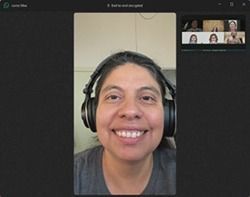
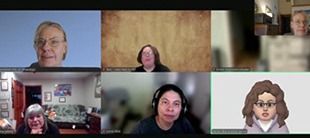
This is what the Zoom gallery view looked like (selecting the option to hide non-video participants). For this demonstration, we can imagine that this is the court’s Zoom meeting. The video of Lorna with the blue background was the video I was injecting into Zoom directly from WhatsApp.

From the LEP’s perspective, this time with Katty Kauffman as our LEP, this is what she saw on her mobile device. She saw her self-view in the top right corner, but the big image on her screen was the Zoom gallery view. The square with the blue background was her WhatsApp video call being inserted into Zoom, and she was able to speak directly with all zoom participants while only being connected to WhatsApp.
This was not a simple tech solution. It did require quite a bit of software, hardware, and a very powerful computer. I would also like to be clear that I am not proposing that interpreters should somehow all become tech gurus and try to help the courts bridge in LEPs for all types of cases on a regular basis. I would however like to encourage the courts themselves to not limit their view of what is possible. Courts have a responsibility to provide equal access regardless of language needs. There are occasions when the courts need to meet people where they are and make it possible for them to truly access the court process, truly equal access, without limiting the court’s ability to see and hear them, or their access to see and hear the court.
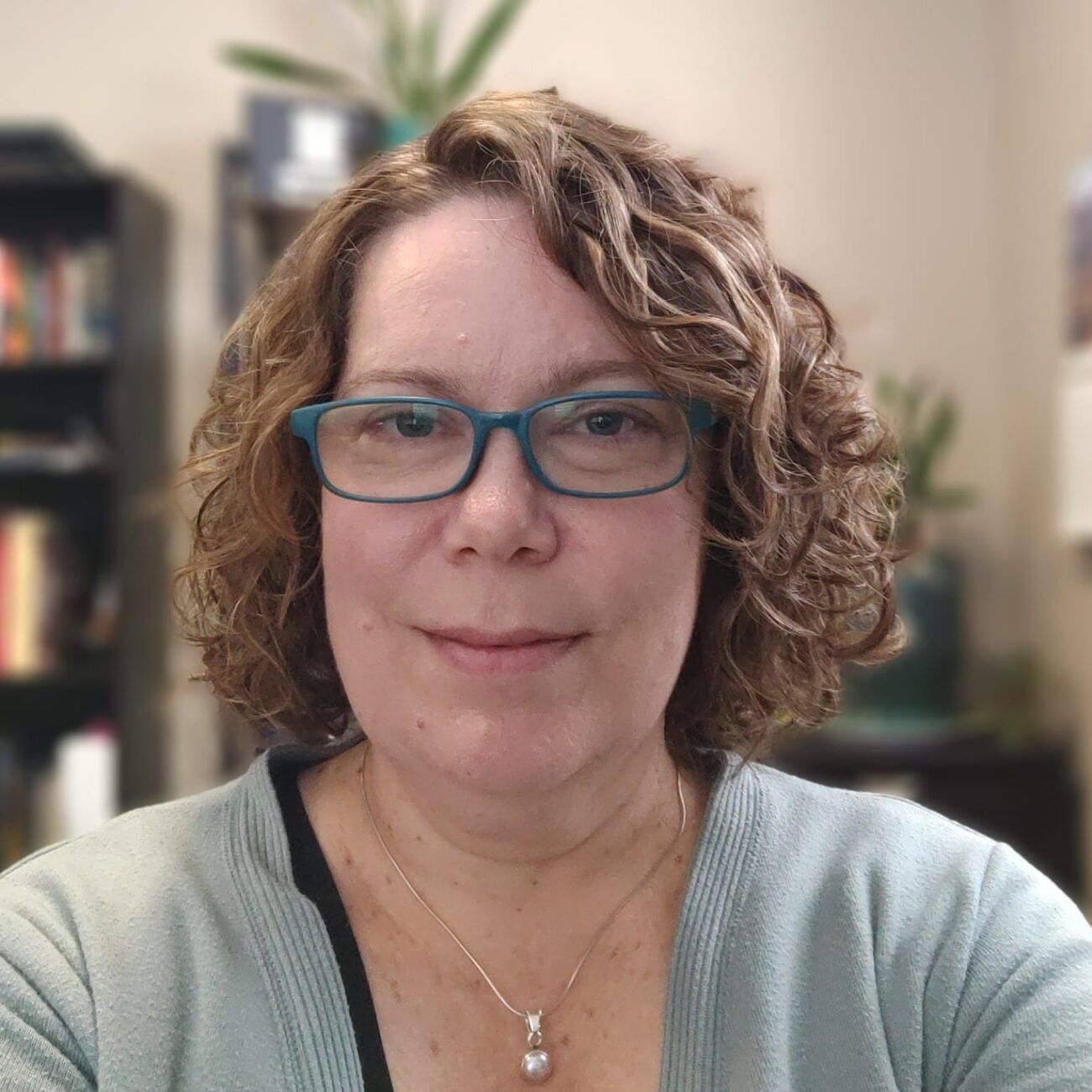
Aimee Benavides is a federally certified interpreter and court certified in California, New Jersey, and Louisiana. She currently serves as Chair of the Executive Committee of ASTM F-43, Language Products and Services. She is a former NAJIT Chair and Board member. Over the past 5 years, in addition to interpreting she has also expanded into tech related services that ethically facilitate language access and proper working conditions for interpreters. https://orcid.org/0000-0002-7482-5182

We love to hear from our readers! If you wish to make a comment on this blog post, please use the comment box on the page below the post.
Categories
Select Category
Archives
Select Month
The views and opinions expressed are those of the author and do not necessarily reflect the official position of NAJIT.
Recent Posts